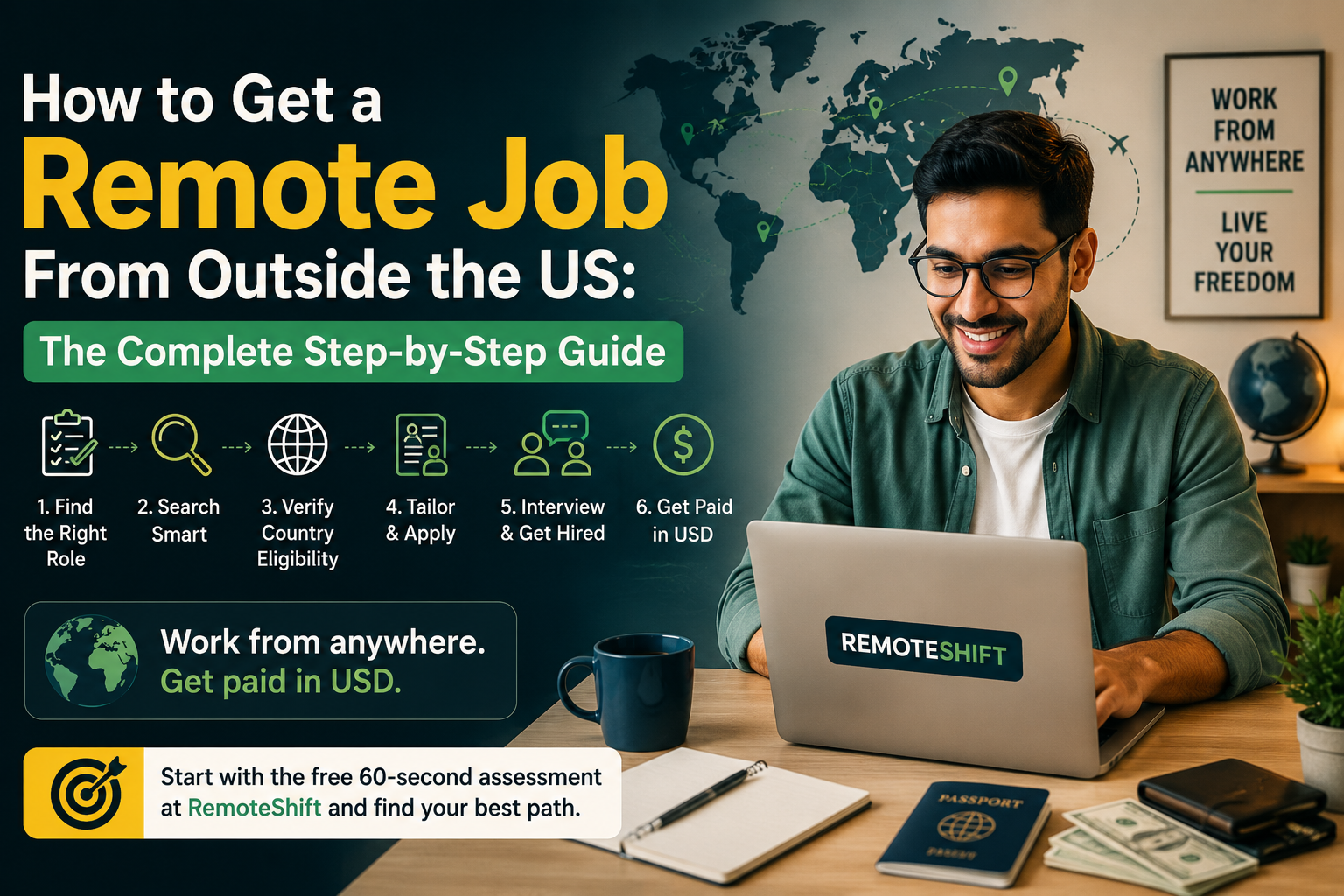
How to Get a Remote Job From Outside the US: The Complete Step-by-Step Guide
A job listing that says "remote" does not always mean open to your country. A company might hire:
- Only in one country
- In a specific list of countries
- Across a whole region
- Worldwide
- As an international contractor
- Through an Employer of Record in your country
Before you spend real time applying, confirm which one applies: country eligibility, region, time-zone overlap, employee or contractor status, work authorization if relevant, and payment currency. This simple check can save you a lot of wasted time and effort.
Start With the Right Role
Searching "remote jobs" returns thousands of listings with nothing to do with your background. Start with RemoteShift's free remote career assessment instead. It takes about a minute and helps you identify which of 13 remote career paths may fit your background, along with an indicative earning range. If virtual assistant work sounds like a fit, here's how to become a Virtual Assistant with no experience.
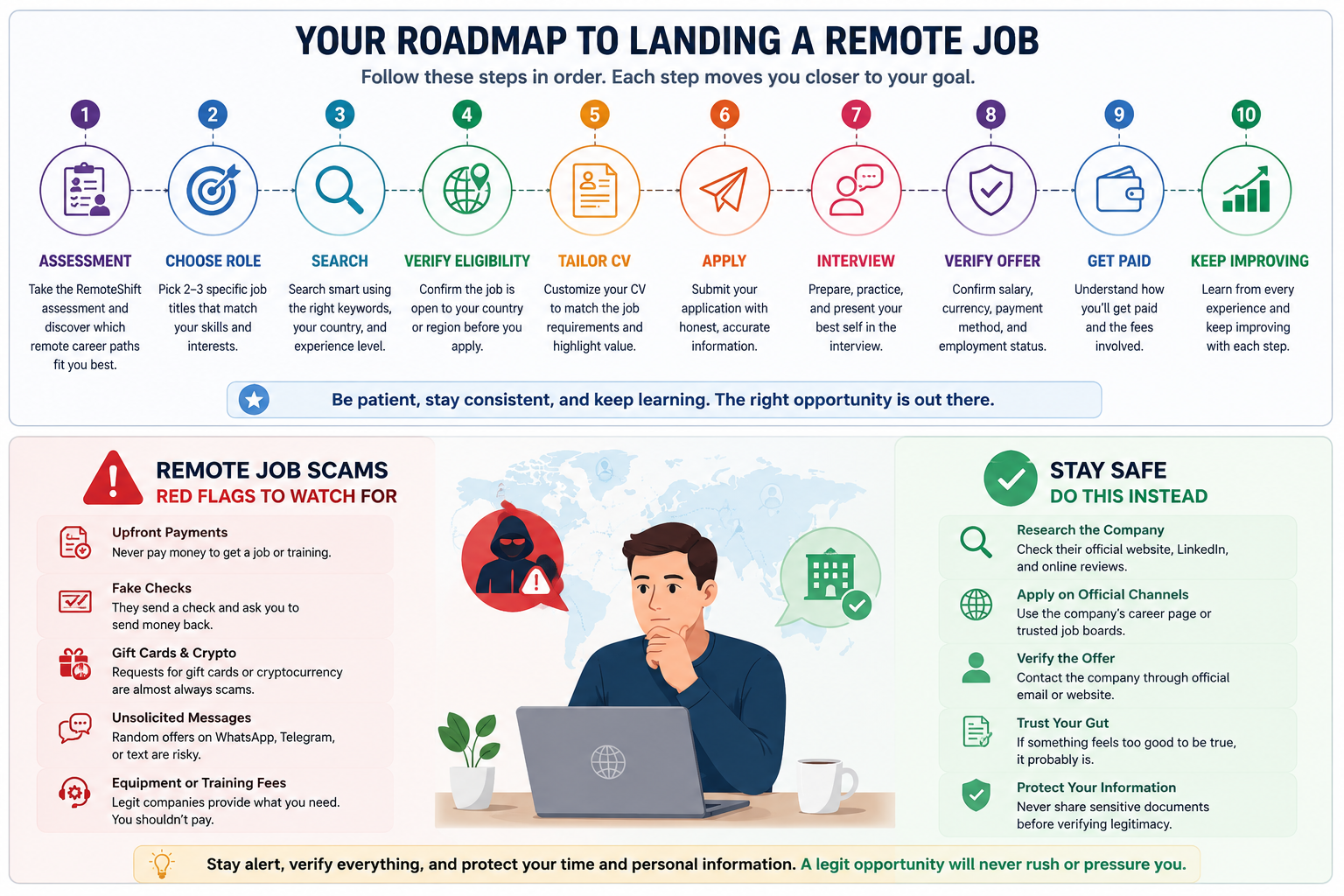
From there, the process moves in order. Turn your result into two or three exact job titles, search with the right terms, and confirm a listing accepts your country before you invest time in it. Tailor your CV to the listing, apply, prepare, interview, and verify the offer and how you'll get paid before you accept. A rejection sends you back one step to improve, not back to zero.
The Full Process: Manual vs AI
Whichever step you're on, AI works best with real detail: your country, target role, assessment result, actual skills and experience, minimum salary, preferred currency, working hours, and whether you want employee or contractor status. Give it that, and it can suggest job titles, generate search queries, compare a listing against your CV, tailor your CV, draft application answers, or run a mock interview.
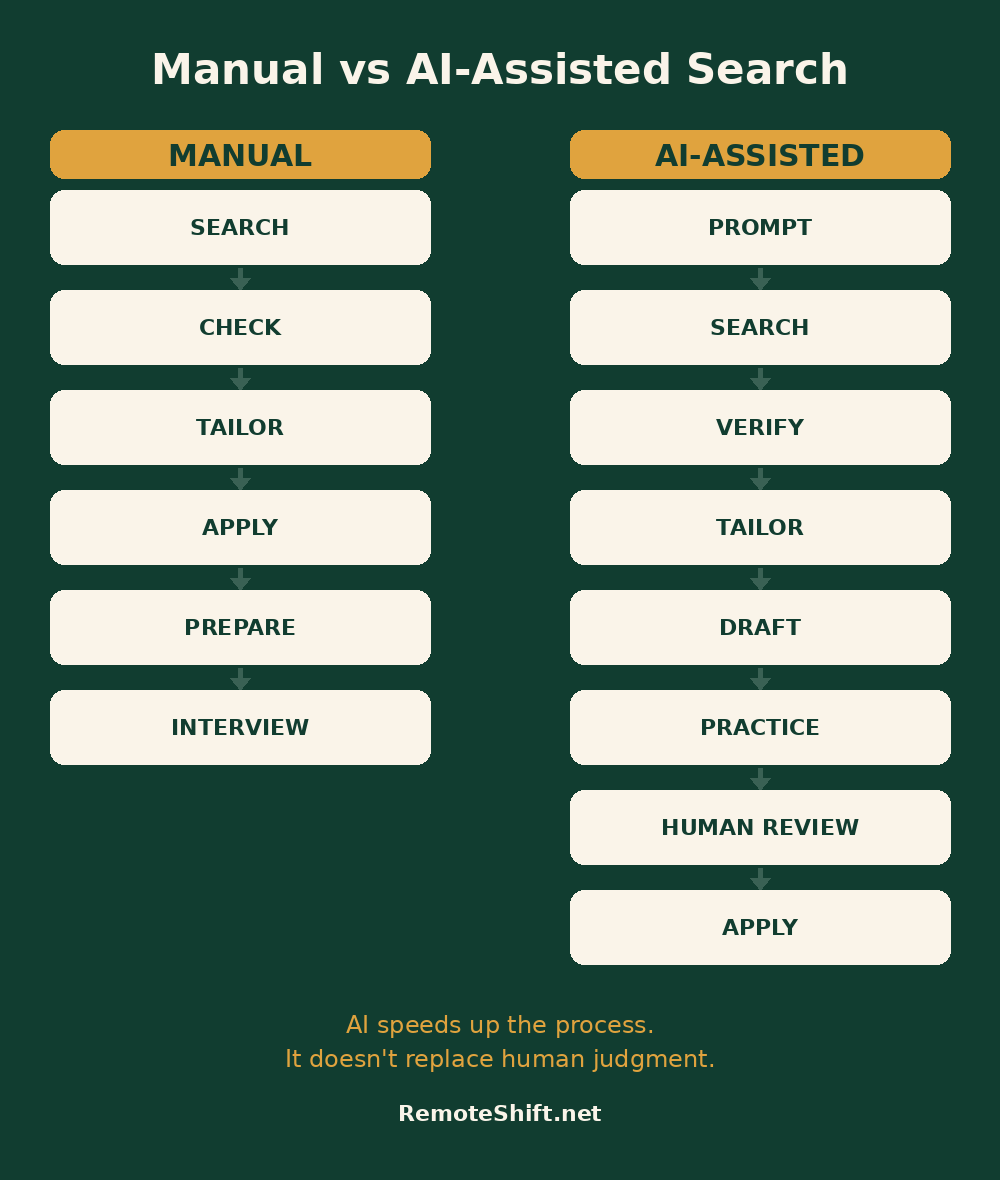
| Step | Manual | AI-assisted | Common obstacle → What to do |
|---|---|---|---|
| Role & job titles | Take the assessment. Note 2-3 exact job titles it points to. | Give AI your assessment result and real skills. Ask for exact job titles that match. | Too many roles to choose from → pick 2-3 titles that match your assessment and real background. |
| Search terms | Search your job title plus "remote" and your country. | Ask AI for 10-20 search combinations for your role, country, and level. | Search returns everything → add your country, role, and experience level to narrow it. |
| Find openings | Check LinkedIn Jobs, Indeed, We Work Remotely, Remote OK, FlexJobs, and company career pages. | Ask AI which boards and companies have a track record hiring your role internationally. | Listing looks promising but vague → open the original post instead of trusting the board's summary. |
| Verify eligibility | Read the listing for "worldwide," a named region, or your country by name. | Ask AI if a listing looks open to your country, then confirm yourself on the original post. | Says remote but doesn't say where → don't assume you're eligible; verify the country requirements on the original listing or with the employer. |
| Tailor your CV | Rewrite your top 2-3 bullets to match the listing's wording, using only real experience. | Give AI your real CV and the listing. Ask for an ATS-friendly rewrite, no invented experience. | One CV sent everywhere → rewrite the top bullets for each specific listing. |
| Apply | Fill out the form yourself. Answer every question with real information. | Let AI draft answers. Review and edit every line before submitting. | Long form, unfamiliar questions → answer with real information, never invented experience. |
| Prepare & interview | Write down likely questions from the listing. Practice out loud. | Ask AI to run a mock interview using the actual job description. | Feeling unprepared → practice real examples pulled from the actual job description. |
| Verify the offer | Confirm salary, currency, employee/contractor status, and payment method before accepting. | Ask AI for a list of questions to ask the employer, then verify legal and payment details yourself. | Salary sounds good, terms are vague → confirm currency, payment method, and status before you accept. |
| Learn from rejection | Track what got rejected and look for a pattern. | Give AI your CV against a listing you didn't get. Ask what might not have matched. | Rejected with no feedback → look for a pattern and fix one weakness before reapplying. |
No job board guarantees international hiring. A worldwide filter narrows the search; it doesn't confirm eligibility for you.
Using AI: never let it invent experience, qualifications, employment history, skills, certifications, achievements, or salary information. AI can polish real experience. It must never invent what isn't there. And never let AI submit an application without you reviewing the company, the salary, the application link, and every answer yourself.
None of this needs AI. Every step above works by hand with the same boards and the same questions.
Where to Search
Use LinkedIn Jobs, Indeed, We Work Remotely, Remote OK, FlexJobs, Google Search, and company career pages directly. Search across several sources, and check the original posting before you assume a listing covers your country.
How to Search From Your Country
Put your location inside the search itself. Someone in El Salvador looking for support work might try:
- "Customer Support Specialist remote El Salvador"
- "Customer Success remote Latin America"
- "Remote customer service worldwide"
- "Customer support Latin America USD"
Swap in your own country and role.
Watch for Remote Job Scams
Never pay money to get a job or to receive your pay. Be wary of:
- A check to deposit, then send money back
- Gift card or cryptocurrency payments
- Unsolicited offers over WhatsApp, Telegram, or text
- Requests for money to receive equipment or training
Verify any offer through the company's official website, not the message you received. For more on where legitimate listings come from, see where the legit remote jobs actually hide.
Prepare for the Interview
Reread the job description and expect a mix of question types: about the role itself, your past experience, why you want this specific job, and a real problem you've solved before. Many interviews open with some version of "tell me about yourself," and remote roles usually add questions about your communication style, your time zone, and your salary expectations.
None of this means memorizing answers. Pull one real example from your own experience for each likely question, and say it out loud once or twice so it comes out naturally, not rehearsed.
How you show up matters too. Dress and speak the way you would for an in-person interview, even on video. Test your camera, microphone, and internet before the call starts, not during it. Have one or two honest questions ready for the interviewer, something like what a typical week looks like.
What to Confirm Before Accepting
- Salary and currency
- Employee or contractor status
- Payment method and platform
- Working hours and time-zone overlap
- Whether the company already supports workers in your country
An American company does not automatically mean USD, and not every remote job pays in it. For the full comparison of payment platforms, see how to actually get paid in USD without losing money to fees. Confirm before you accept.
Don't Give Up After Rejection
One open role can draw applicants from many countries. A rejection does not mean you're unqualified. Someone else may simply have matched what the employer was looking for more closely that day.
Look for a pattern instead. Was the CV strong enough for that specific role? Did you apply to the right type of position? Were skills missing? If you reached an interview, did it go the way you wanted? Fix the one thing you can identify, then apply again. Don't quit because of rejection. Learn from it, improve, and make the next attempt stronger.
Your Roadmap From Here
Assessment, role, search, verify eligibility, tailor CV, apply, interview, verify offer, confirm payment, get hired, learn and improve.
Start with the assessment: remoteshift.net. Free, about a minute, and it points you to which of the 13 paths fits your background before you spend a week applying to the wrong ones.